
 Rewards
Festive and Incentive Schemes in India: How to Get Every Reward From One Partner
Running a festive or incentive scheme? Get every reward, from 350+ gift cards to appliances, tech and vehicles, from one partner. Here's how to plan the slabs and launch with Budgetree.
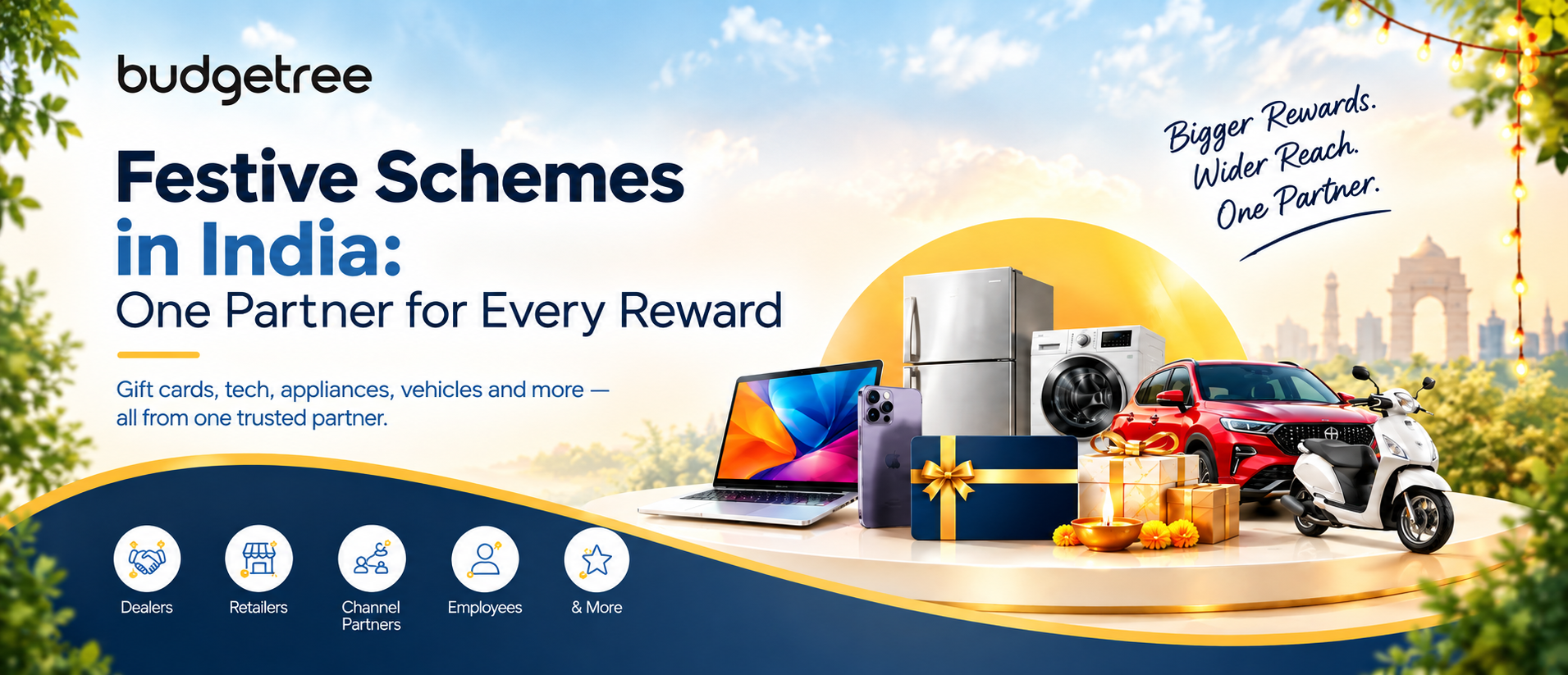
Diwali is six weeks away and your sales head has just signed off on a dealer scheme. The targets are set, the slabs are drawn, and everyone is excited. Then someone asks the obvious question: who is going to supply the rewards?
Gift cards come from one vendor, phones and laptops from another, appliances from a third, and the two-wheeler from a dealer down the road. A few weeks later you are chasing four suppliers for updates while your dealers keep asking when their rewards will arrive.
Most festive and incentive schemes in India don't fail because the idea was weak. They struggle because the rewards behind each slab are spread across too many vendors. This guide explains how a good scheme is put together, how to design slabs that people actually care about, and how to get every reward from one partner instead of five.
If you run schemes as part of your job, whether in sales, marketing, channel management or HR, you should find something useful here. There are examples, a simple planning calendar, common mistakes and a full FAQ at the end.
What you'll get from this guide?
How festive, dealer, sales and employee schemes are usually structured
A slab-by-slab reward ladder, from small wins to grand prizes
Scheme ideas for dealers, retailers, sales teams, employees and customers
A seven-step plan and a planning calendar you can start using this week
A checklist for choosing a reward partner, and answers to ten common questions
What is a festive or incentive scheme?
A scheme is a limited-period programme where people earn rewards for hitting a goal. The goal could be a sales target, a purchase volume, a customer referral, or just taking part in a festive campaign. The reward is what turns a target into something people actually want to chase.
Companies run schemes for several groups of people:
Dealers and distributors: rewards for bigger purchase volumes during the peak season.
Retailers and channel partners: rewards for repeat orders, stock lifting and loyalty.
Sales teams: contests with milestones and a leaderboard.
Employees: festive or milestone rewards around Diwali, New Year or work anniversaries.
Customers: thank-you rewards for buying, referring or staying loyal.
Most schemes follow one of four structures. In a slab-based scheme, a higher target earns a bigger reward. In a target-based scheme, one goal earns one reward. A contest or leaderboard rewards the top performers only. An instant-reward scheme gives something right after a purchase. Plenty of companies mix two or more of these.
Whatever the structure, every scheme makes the same promise. Participants are told what they can win, and the company has to deliver it. That's where most schemes are won or lost.
Why schemes fall apart when rewards come from too many vendors?
Hardly any company starts with a single reward partner. Vendors get added over time: one for gift cards, one for electronics, one for appliances, and a local dealer for vehicles. On paper that looks like a lot of choice. Once the scheme is live, it turns into five familiar headaches.
Too many people to chase. Each vendor has its own contact, terms and deadlines, so your sales operations or marketing team ends up managing a mini project for every one of them.
A patchy reward list. Schemes work better when people can pick what they really want. If no single vendor covers everything, you either limit the choices or spend weeks stitching a list together.
Uneven delivery. One vendor delivers in a week and another takes a month. Winners talk to each other, and the slowest delivery becomes the story everyone remembers.
Messy tracking. Who has claimed what? Which rewards are still pending? With separate vendors, the answers sit in separate spreadsheets.
Too much paperwork. Several purchase orders, invoices and reconciliations mean more work for your finance team and more chances for mistakes.
There's a quieter cost too. A late reward hurts trust in the scheme itself, and dealers and partners remember that when you announce the next one.
The answer isn't to work harder. It's to cut down the number of vendors you depend on.
Every scheme reward in one place: what Budgetree offers?
Budgetree Technology Pvt. Ltd. was set up around a simple idea: you shouldn't need ten suppliers to run one scheme. Whatever sits in your slabs, from a small gift card to a four-wheeler for your best distributor, you can get it from one place, with one point of contact and one way of working.
Here's how our range fits the different levels of a typical scheme.
Entry slabs: 350+ brand gift cards
Gift cards are the most flexible reward you can offer. With more than 350 brands to choose from, dealers, retailers, employees and customers can pick brands they already use. They work well for entry slabs, instant rewards, spot recognition and referral bonuses.
Middle slabs: products people actually want
Electronics and daily tech products for contests and milestone slabs.
Home appliances and articles that suit dealer, retailer and employee schemes.
Home decor items that are a natural fit for Diwali and New Year schemes.
Mobile phones and laptops for strong performers and annual awards.
Top slabs: big-ticket grand prizes
Two-wheelers and four-wheelers give dealers, distributors and sales teams something big to work towards. When the top prize is visible from day one, targets feel a lot more exciting.
More categories to widen the choice
These popular options can be added to any slab so people have more to choose from:
Festive gift hampers, dry fruits and sweets
Kitchen appliances and cookware
Smartwatches, earphones and speakers
Fitness and wellness products
Luggage and travel accessories
Home fragrance and candles
Drinkware and lifestyle accessories
Furniture and home essentials
What this means for you?
You explain your scheme once and one team takes it forward. Small, mid-level and grand prizes all sit in the same catalogue. Winners get more choice, so you hear fewer "I didn't want this" complaints. And with fewer vendors involved, there are fewer places for a delay to creep in.
How to design scheme slabs that keep people chasing?
The best schemes use a reward ladder. Each step feels reachable, and the top step feels worth the effort. Here's a simple example for a festive dealer scheme. The percentages are only for illustration, so set yours based on your own numbers.
Slab 1, the quick win: reach 100% of the base target and earn a gift card. It's easy enough that most dealers get moving.
Slab 2, the everyday reward: reach 125% and earn a home appliance, decor item or tech product.
Slab 3, the aspirational reward: reach 150% and earn a smartphone or laptop.
Slab 4, the grand prize: the top performer in each region wins a two-wheeler or four-wheeler.
A few things make a ladder work. Keep the first slab within reach of most participants. Make each step clearly better than the one before it. Show the grand prize from the first day. And where you can, let winners choose from a good range of rewards.
Since one partner covers every slab, you can plan the whole ladder in a single conversation instead of negotiating with four different vendors.
Scheme ideas and reward picks for every group
A scheme works best when it suits the people in it. A dealer chasing a festive target thinks very differently from a new joiner celebrating a first Diwali with your company. Here's a starting point for each group.
Dealers and distributors: the aim is festive-season sales. Slab-based schemes with appliances, electronics and two-wheelers or four-wheelers as grand prizes tend to work best.
Retailers and channel partners: the aim is repeat orders and loyalty. Instant gift cards, electronics and home appliances are good picks.
Sales team: the aim is to push targets. Use milestone rewards, with gift cards at the start, mobiles and laptops in the middle, and a vehicle for the top performers.
Employees: the aim is appreciation and goodwill. Gift cards, home decor, daily tech products and small appliances usually go down well.
Customers and referrers: the aim is to say thank you and get more referrals. Instant gift cards and premium tech products suit this group.
A simple rule of thumb: use gift cards for flexibility, products for excitement, and big-ticket rewards for the moments that deserve a proper celebration.
Three scheme examples
These are illustrative scenarios, but they show how a single reward partner fits very different schemes.
Example 1: A Diwali dealer scheme for an appliance brand
A consumer durables company wants its dealers to push sales in the six weeks before Diwali. It sets up three slabs. Dealers who cross the first target get gift cards. The second slab earns electronics or home appliances. The top three dealers in each region win a two-wheeler.
With several vendors, that means one supplier for the cards, another for the products and a third for the vehicles. With one partner, all three slabs come from the same catalogue, with one invoice trail and one place to track everything. The sales team announces the scheme once, and every dealer knows exactly what to aim for.
Example 2: An employee festive scheme for a 1,200-person company
An HR team has a fixed budget per employee and wants to avoid the usual reaction to yet another box of sweets. Instead, employees choose from gift cards, home decor items or daily tech products within their budget band.
Employees get something they actually want, and it all runs through one process. HR spends its time on the celebration instead of chasing vendors.
Example 3: A quarter-long sales incentive contest
A financial products company runs a contest for its field team. The first milestone earns a gift card, the second a smartphone and the third a laptop. The top performer wins a four-wheeler.
Because every reward is available in one place, the company plans the whole contest in one go instead of negotiating with four suppliers. The contest also builds energy, because everyone can see the grand prize from the very first day.
How to plan and run a festive scheme in 7 steps
Decide what the scheme is for. Is it higher festive sales, more repeat orders, stronger dealer loyalty or employee appreciation? A clear goal makes every other decision easier.
Know who's taking part. Split them into dealers, retailers, the sales team, employees or customers. What motivates each group, and what they consider a good reward, is different.
Set targets and a budget. Base targets on past numbers and realistic growth. Include the cost of rewards, delivery and communication, and keep a small buffer.
Design the slabs and rewards. Build the reward ladder with a mix of gift cards, products and one or two grand prizes. Keep the lower steps achievable and the top step aspirational.
Write simple rules. Cover who is eligible, the scheme period, how slabs are calculated and how rewards are claimed. Unclear rules are the quickest way to end up with disputes.
Launch with clear communication. Share the slabs, rewards and dates in a simple, visual format, and put the grand prize front and Centre.
Track, deliver and follow up. Watch progress, send reminders at milestones, confirm deliveries and ask for feedback. A scheme only works if winners get their rewards on time and are happy with them.
A single reward partner makes steps 4 to 7 much easier, because the catalogue, delivery and tracking are all handled by one team.
A simple planning calendar
6 to 8 weeks before launch: fix the goal, participants, targets and budget, and shortlist reward categories.
4 to 6 weeks before: finalize the slabs and rules, and confirm your reward partner and catalogue.
2 to 4 weeks before: announce the scheme with clear communication and visuals.
During the scheme: track progress, send milestone reminders and celebrate early achievers.
After it closes: verify results, confirm winners, arrange delivery, collect feedback and note what to change next time.
Five common scheme mistakes
Starting too late. Leave enough time for design, communication and delivery.
Slabs that are too hard or too easy. If the first slab feels out of reach, people give up. If it's too easy, the scheme adds nothing. Test your targets against past data.
Unclear rules. If people can't tell how to win, they lose interest. Keep the rules short.
No grand prize to look forward to. A big-ticket reward creates talk and energy, so include at least one.
Too many suppliers. Every extra vendor adds delay and risk, so consolidate where you can.
How to choose a reward partner for your scheme?
Before you commit to a partner for your next scheme, put these eight questions to them. A good one will answer all of them without fuss.
Range: can they cover gift cards, products and big-ticket rewards for every slab, or will you still need other vendors?
Brand variety: do they offer brands your participants will recognize and want?
Scale: can they handle a 50-person contest as easily as a scheme with 5,000 dealers?
Delivery: how do they manage timelines during the festive rush?
Tracking: will you be able to see who has claimed, who is pending and what has been delivered?
Support: is there one person accountable for your scheme, or will you be passed between departments?
Pricing: are quotes clear, with no surprise delivery or handling charges?
Paperwork: do they give you the invoices and records your finance team needs?
If the answer to the first question is no, you're back to the multi-vendor problem this guide started with.
Why scheme owners choose Budgetree?
Budgetree exists to take away the biggest headache in running a scheme, which is putting the rewards together from many suppliers. This is what that means in practice.
Every slab, one place. From 350+ brand gift cards to electronics, home appliances, home decor, mobiles, laptops, two-wheelers and four-wheelers, your whole reward ladder sits in one catalogue.
One partner, one process. You brief once, plan once and follow up with one team. That saves hours for sales operations, marketing and HR.
Fits any scheme. Festive dealer schemes, sales contests, employee programmes and year-long incentive plans all work, and you don't have to shrink your idea to match what a vendor can supply.
Rewards worth chasing. A wide catalogue lets participants pick rewards they truly value, so the scheme stays motivating.
Fewer things that can go wrong. With no vendor juggling, there are fewer chances for a delay or a missing reward to spoil your scheme.
You bring the scheme idea and the audience. We bring the rewards and get them to the right people.
Frequently asked questions about festive and incentive schemes
What is a festive or incentive scheme?
It's a limited-period programme where people earn rewards for reaching a goal, such as a sales target, a purchase volume or a referral count. Companies run them for dealers, distributors, retailers, sales teams, employees and customers.
What types of schemes can a company run?
The common ones are slab-based schemes (a higher target earns a bigger reward), target-based schemes (one goal, one reward), contests or leaderboards (only the top performers win) and instant-reward schemes (a reward right after a purchase). Many companies combine two or more.
Why use one reward partner instead of several vendors?
With one partner you have one contact, one process and one place to track everything. With several vendors you deal with different timelines, payments and follow-ups, and a delay from any one of them can hold up the whole scheme.
What rewards can I include in a scheme through Budgetree?
You can build your scheme around 350+ brand gift cards, electronics, home appliances, home decor, daily tech products, mobile phones, laptops, two-wheelers and four-wheelers. That covers everything from entry-level rewards to grand prizes.
Should scheme rewards be gift cards or physical products?
It depends on the audience. Gift cards are flexible and suit large groups with different tastes. Physical products feel more exciting and personal. Many good schemes use both, with cards in the lower slabs and products in the higher ones.
Can I offer a two-wheeler or four-wheeler as a scheme reward?
Yes. Vehicles make excellent grand prizes because they give participants something big to aim for. Most companies keep them for the highest slab or for the top performer in each region.
How early should I start planning a festive scheme?
Six to eight weeks before the festival or launch date is a comfortable window. That gives you time to design the slabs, announce the scheme and arrange deliveries without a last-minute rush.
How do I set the right slabs and targets?
Start from past performance and realistic growth. Keep the first slab within reach of most participants, make every step clearly better than the last, and save the grand prize for a real stretch. It helps to look at last year's results before finalizing the numbers.
Do I need to think about tax when running a scheme?
Possibly. The tax treatment of rewards, gifts and vouchers can vary depending on who receives them, their value and how they are given. Please check the current rules with your chartered accountant or tax advisor before you finalize the scheme.
How do I get started with Budgetree, and does the size of my scheme matter?
Our range covers everything from a small employee festive scheme to a large multi-slab dealer scheme. Get in touch with three details: who the scheme is for, your rough budget and your timeline. We'll help you shape the reward ladder and plan the delivery.
Planning your next scheme
A good scheme should feel fair to the people in it and manageable for the people running it. When rewards come from many different places, that balance is hard to keep. When everything comes from one partner, it gets a lot easier.
So, before you launch your next festive scheme, dealer programme or sales contest, ask yourself one thing: can I get every reward for every slab in one place? With Budgetree, you can.
Want help planning your scheme? Visit budgetree.in or get in touch with our team. Tell us who the scheme is for, your budget and your timeline, and we'll help you turn the idea into a scheme people talk about for the right reasons.
Ready to transform your rewards & engagement program?
See how Budgetree helps teams launch, automate, and measure engagement at scale.
Continue reading
More insights from the Budgetree team

Navratri Incentive Scheme 2026: How to Run a 9-Day Dealer and Sales Scheme People Remember
A Navratri incentive scheme runs 11-19 October. Set simple slabs for dealers and sales teams, announce a big Dussehra prize and get every reward from one partner.
Read more
The All-In-One Redemption Portal Loyalty Programs Have Been Missing
Budgetree's Redemption Portal lets loyalty points convert into 350+ gift cards, digital gold and silver, merchandise, vehicles, travel, or direct UPI/DBT bank transfer, all through one simple API or SDK integration.
Read more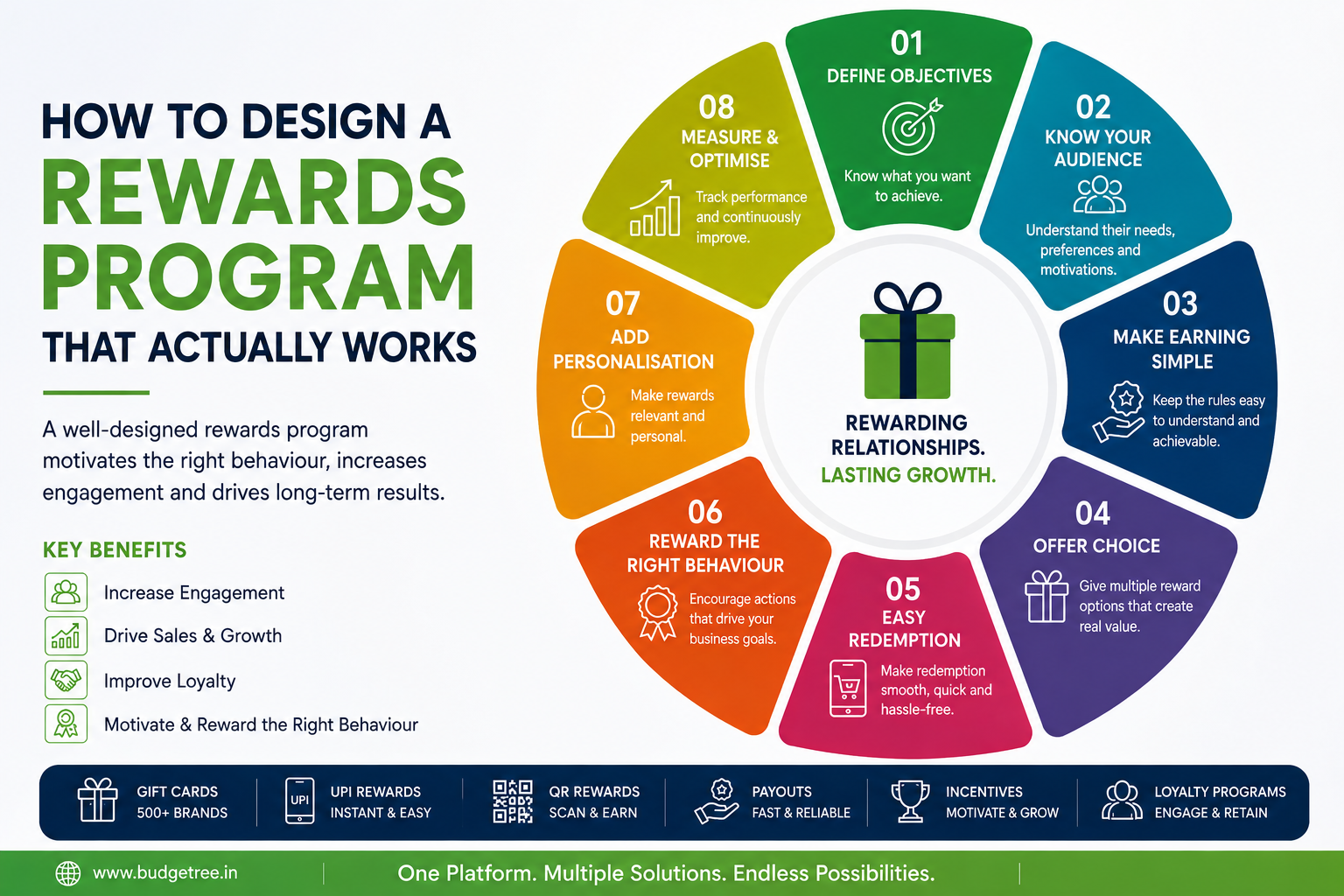
How to Design a Rewards Program That Actually Works
A rewards program is easy to launch. A rewards program that customers, employees, dealers or channel partners actually use is much harder. Many businesses ma...
Read more