
 Rewards
What Is a Payout API?
A Payout API (Application Programming Interface) allows a business application to communicate with a payment or banking system and initiate payouts electronic...
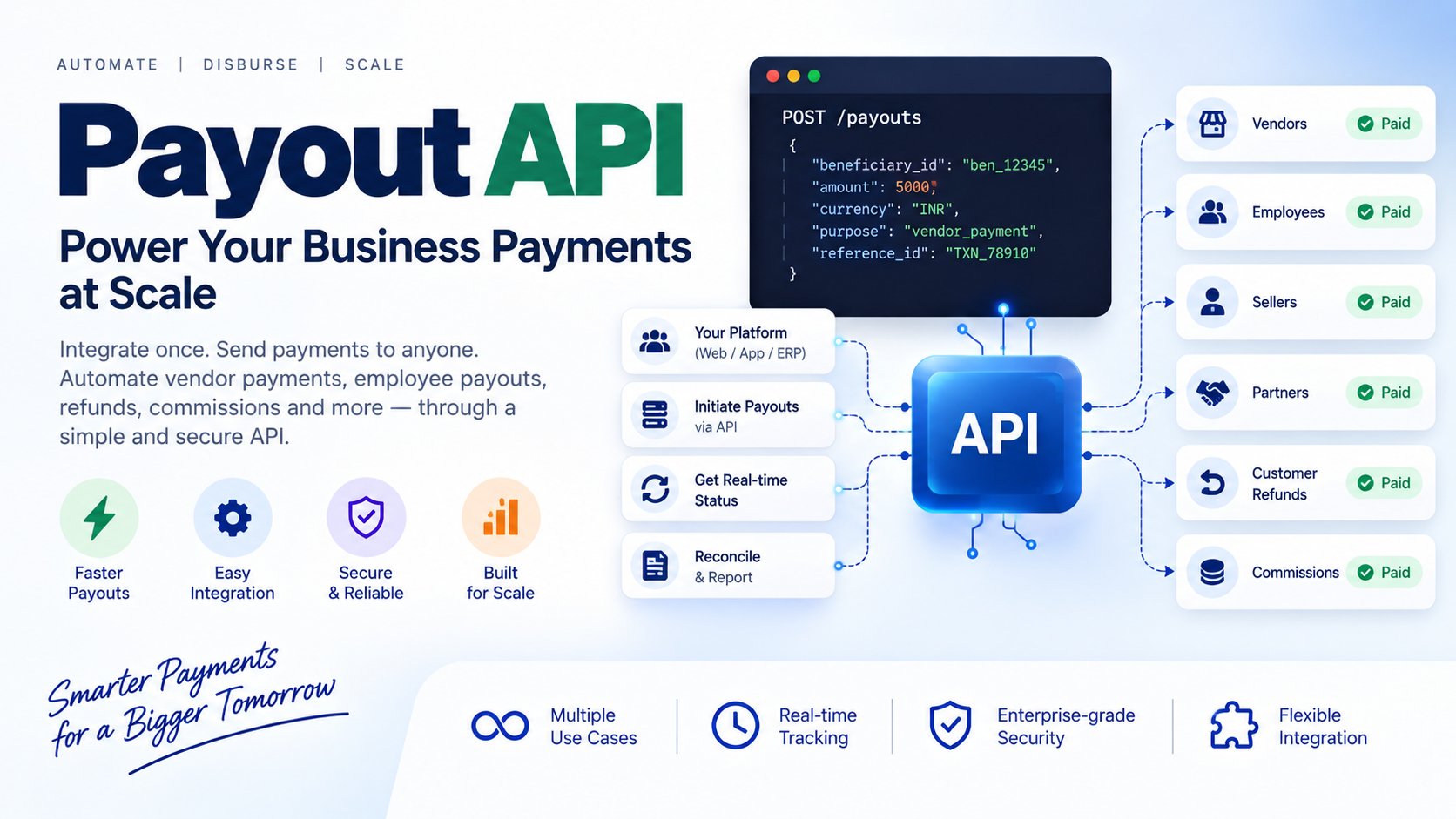
A Payout API (Application Programming Interface) allows a business application to communicate with a payment or banking system and initiate payouts electronically.
In simple terms:
Your Business System → Payout API → Payment Infrastructure → Beneficiary Bank Account
For example, imagine a marketplace with 10,000 sellers.
Instead of manually processing payments to each seller, the marketplace can integrate a Payout API into its technology stack and automate the process.
The business system can send payout instructions through the API, receive transaction status updates and maintain records for reconciliation.
How Does a Payout API Work?
A typical payout process can be broken down into several steps.
1. Business Creates a Payout Request
The business system sends information such as:
Beneficiary details
Amount
Reference ID
Payment purpose
Additional transaction information
to the Payout API.
2. Beneficiary Is Validated
The payment system validates the beneficiary information according to the supported process.
3. Payout Is Initiated
Once the request passes the required checks, the payout is initiated through the appropriate payment infrastructure.
4. Transaction Status Is Returned
The API provides a transaction status such as:
Successful
Failed
Pending
Processing
5. Business Updates Its System
The business application can use the response or webhook to update its internal records.
6. Reconciliation
Transaction information can then be matched with the business's internal records for accounting and operational reconciliation.
Payout API vs Manual Payments
The difference becomes significant when payment volumes increase.
FeatureManual PaymentsPayout APIPayment InitiationManualAutomatedLarge Payment VolumesDifficult to manageDesigned for scaleTransaction TrackingManualAPI-basedStatus UpdatesManual checkingAutomatedReconciliationTime-consumingCan be automatedIntegrationLimitedApplication-to-applicationOperational EffortHighLower
For businesses processing a large number of payouts, automation can significantly simplify operations.
Why Do Businesses Need a Payout API?
1. Automate Payments
Businesses can trigger payouts directly from their existing applications or internal systems.
2. Reduce Manual Work
Finance and operations teams don't need to manually initiate every individual transaction.
3. Process Payments at Scale
An API-based infrastructure can support businesses that need to process large numbers of payouts.
4. Track Transaction Status
Businesses can receive structured transaction responses and monitor payment states.
5. Improve Reconciliation
API-based transaction data can be connected with internal accounting and reconciliation systems.
6. Build Better Customer Experiences
Fast and automated payouts can improve experiences for vendors, sellers, employees, agents and customers.
Common Payout API Use Cases
A Payout API can support many business models.
Marketplace Payouts
Marketplaces can automate payments to sellers, vendors and service providers.
Employee Payments
Businesses can automate reimbursements, incentives, commissions and other employee-related payments.
Vendor Payments
Companies can integrate payout functionality into their procurement and finance workflows.
Customer Refunds
Businesses can automate eligible refunds and monitor their status.
Insurance
Insurance platforms can automate payments to customers or other beneficiaries where applicable.
Gig Economy Platforms
Platforms can pay delivery partners, freelancers, drivers and other gig workers.
Affiliate & Commission Payments
Businesses can automate commission payouts to partners and affiliates.
What Should You Look for in a Payout API?
Choosing a Payout API isn't only about transaction speed.
Businesses should evaluate the complete infrastructure.
API Documentation
Clear documentation makes integration easier for developers.
Sandbox Environment
A testing environment allows businesses to test integrations before going live.
Webhooks
Webhooks can help businesses receive real-time transaction status updates.
Beneficiary Management
The system should provide a structured way to manage beneficiaries.
Transaction Tracking
Businesses should be able to track individual transactions using unique reference IDs.
Reconciliation
Payment data should be easy to export, integrate or reconcile with internal systems.
Security
Payment infrastructure should follow appropriate security, authentication and compliance requirements.
Scalability
The API should be capable of supporting growing transaction volumes.
Payout API Security
Security is one of the most important considerations when building automated payment infrastructure.
A business should evaluate areas such as:
API authentication
Access controls
Encryption
Request validation
Transaction monitoring
Webhook security
Audit logs
Rate limiting
Fraud and risk controls
The exact security architecture will depend on the payment infrastructure and business use case.
Payout API and Budgetree
For businesses, payouts shouldn't require finance and operations teams to manually manage every transaction.
Budgetree's payout infrastructure can help businesses create more automated and structured payment workflows.
Businesses can use payout capabilities for use cases such as:
Vendor Payments → Employee Payouts → Customer Refunds → Marketplace Settlements → Partner Payments
The bigger advantage is not simply sending money.
It is having a structured workflow around:
Initiation → Processing → Status → Reconciliation → Reporting
This can help businesses reduce manual operational effort and build a more scalable payout process.
Payout API: The Future of Business Payments
As businesses become increasingly digital, payment infrastructure needs to become more automated.
A modern Payout API allows businesses to embed payment capabilities directly into their applications instead of treating payments as a completely separate manual process.
This means a marketplace can automatically pay sellers.
A company can automate vendor payments.
A platform can process partner commissions.
A business can initiate refunds programmatically.
And finance teams can get better visibility into the entire payment lifecycle.
Frequently Asked Questions
What is a Payout API?
A Payout API is an interface that allows businesses to integrate automated payment functionality directly into their applications or internal systems.
What is payout automation?
Payout automation is the process of using technology to automatically initiate, process, track and reconcile business payments.
Who uses Payout APIs?
Marketplaces, fintech companies, e-commerce platforms, enterprises, gig-economy businesses, insurance platforms and other companies with regular payout requirements can use Payout APIs.
Is a Payout API suitable for bulk payments?
Yes. API-based payout infrastructure is particularly useful for businesses that need to automate large numbers of payments.
What is a webhook in a Payout API?
A webhook is a mechanism that allows the payment system to send transaction updates back to a business application, such as when a payout succeeds or fails.
Conclusion
A Payout API turns payments from a manual operational activity into an integrated part of a business's technology stack.
Instead of manually processing every payment, businesses can automate payout initiation, receive transaction updates, manage large payment volumes and simplify reconciliation.
For businesses looking to scale their payment operations, the right Payout API can provide the infrastructure needed to make payouts faster, more automated and easier to manage.
Budgetree — powering smarter business payments.
Ready to transform your rewards & engagement program?
See how Budgetree helps teams launch, automate, and measure engagement at scale.
Continue reading
More insights from the Budgetree team
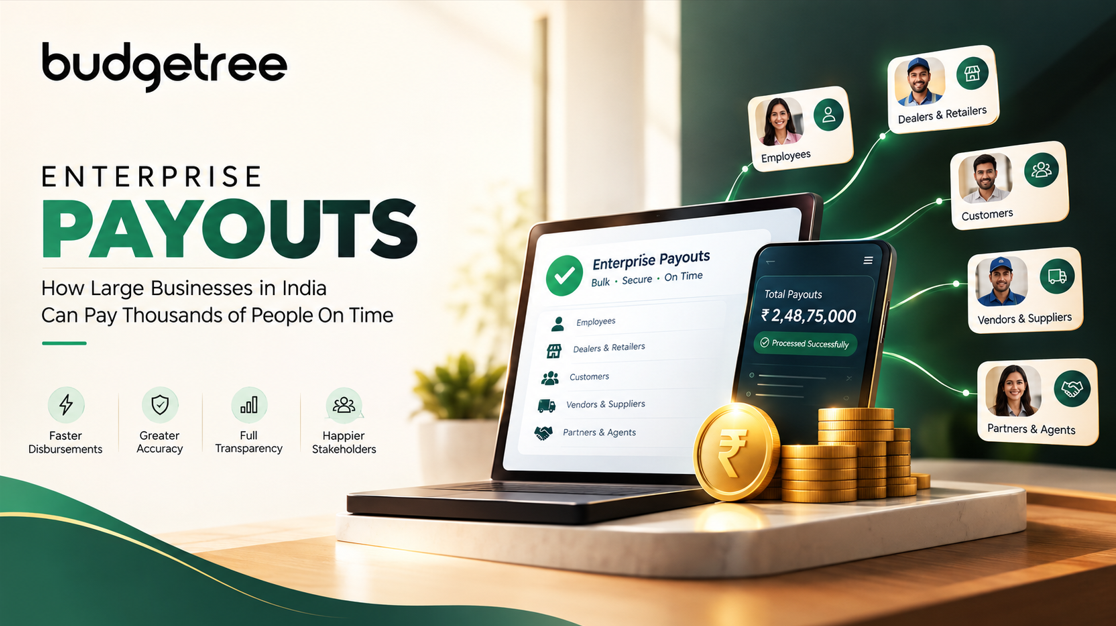
Enterprise Payouts in India: A Simple Guide | Budgetree
Budgetree helps large businesses automate bulk payouts via UPI, IMPS and NEFT with real-time tracking, easy reconciliation and audit-ready records, all from one platform.
Read more
UPI MDR 2026 Explained: The Complete Guide for Merchants and Businesses
NPCI's new 0.4% UPI MDR takes effect 15 October 2026 on merchant payments above ₹2,000, capped at ₹300. Consumers and small merchants stay exempt - here's what businesses must know before the deadline.
Read more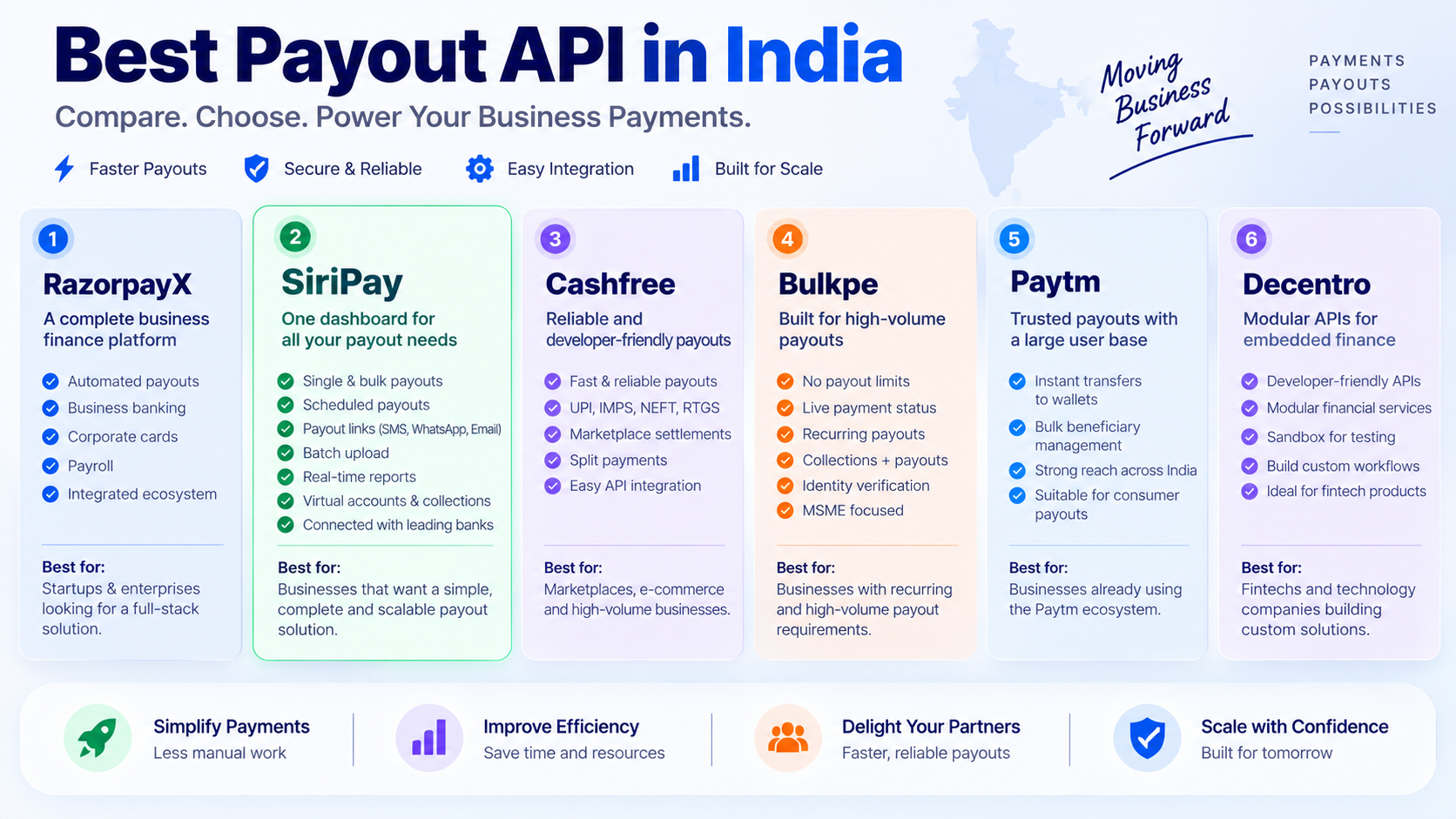
Best Payout APIs in India: RazorpayX, SiriPay, Cashfree, Bulkpe, Paytm & Decentro
Over the last few years, businesses in India have moved from manual payments to automated payouts. For NBFCs, marketplaces, logistics companies, e-commerce bu...
Read more